Film basics · 8 min read
Can window film reduce heat without making a room dark?
Published · Last revised · Written by the Window Tint DE editorial team · Published by Shore Tint & More, a 3M Authorized Window Film Dealer. Editorial disclosure
Brightness and heat are two different measurements
Solar-control films combine different levels of visible-light transmission, absorption and reflection. Two films can let through similar amounts of daylight yet differ in how much total solar energy they reject, and two films that look alike can perform differently. That is why the comparison has to be made figure by figure, for the exact film and shade.
Material or marketing names — ceramic, multilayer, spectrally selective — describe how a product is built, but they do not by themselves establish its performance. Compare the visible-light transmission and total-solar figures for each exact product on the same reference glass. Solar-control film generally changes visible-light transmission; clear-looking does not mean unchanged daylight, so the real question is whether the trade-off suits this room.
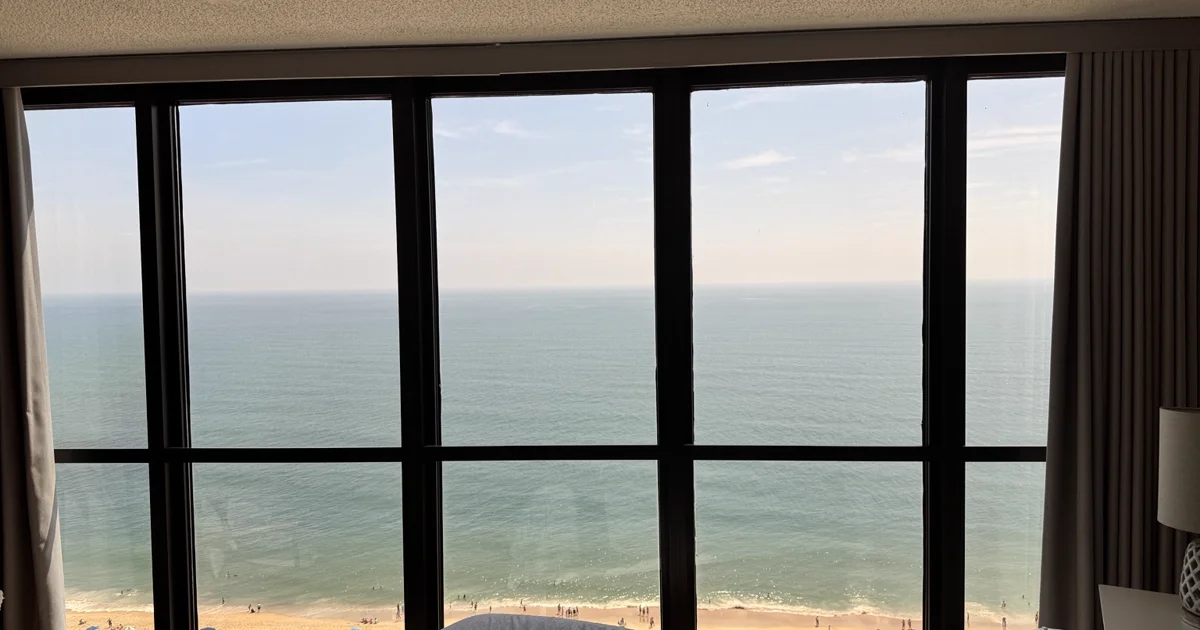
Actual Shore Tint & More installation — Sea Colony · Bethany Beach, DE; 3M Prestige 70 · beachfront condo.
View source case study ↗ — Sea Colony · Bethany Beach, DEFour things to keep separate
- Daylight transmission — how much visible light passes through. This drives how bright the room looks and how much glare remains.
- Total solar performance — how much of the sun's total energy the filmed glass rejects. This is what relates to solar heat gain; it is not the same number as visible light.
- Appearance — color, interior and exterior reflectance, and how the film looks next to unfilmed panes or neighboring units. Two films with similar light transmission can look quite different.
- Glass compatibility — whether the film is approved for your glass type (insulated, Low-E, laminated, tempered, large or partly shaded panes). A good-looking film that isn't appropriate for the glass is not a good choice.
Sample review: what to compare and what to ask for
Use this table when you are comparing two or three candidate films. It is a checklist for the conversation, not a performance chart.
| Your goal | What to compare | Evidence to request |
|---|---|---|
| Keep the room bright | Visible light transmission of each candidate, and how each sample looks against an unfilmed pane | Current manufacturer data sheet for the exact product and shade, with the reference glass it was measured on |
| Reduce solar heat | Total solar energy rejected (or solar heat gain coefficient) for the same reference glass | The same data sheets — compare products only on matching reference glass, never across different glass |
| Limit UV and fading | Stated UV rejection, remembering visible light and heat also contribute to fading | Manufacturer data sheet; see our fading guide for the limits |
| Avoid a mirrored look | Interior and exterior visible reflectance; how the sample looks from outside by day and from inside at night | Data sheet reflectance figures plus an on-glass sample viewed from both sides |
| Protect the glass | Whether each film is appropriate for each glass type in the room | Manufacturer film-to-glass guidance and the installer's written survey notes per window type |
| Know what's covered | Who backs the warranty, for which glass, and what voids it | The written warranty document for your glass type, not a summary |
How to check samples on your actual glass
- Pick the window that bothers you most and schedule the sample check for the time the heat or brightness problem actually happens — a west room at 4 p.m. tells you more than the same room at 10 a.m.
- Apply or hold each sample on the real pane, next to an unfilmed pane of the same window, so you are comparing against your glass rather than a white countertop.
- Stand where you normally sit. Look at the view, the floor and any screens, not just at the sample itself.
- Step outside and look back at the window in daylight, especially in a condo or neighborhood where exterior appearance matters.
- Check again after dark with interior lights on; reflective films can look like a mirror from inside at night.
- If you photograph samples, lock the phone's exposure or use the same settings each time; automatic exposure hides brightness differences.
- A small sample on one pane may look different from a whole filmed wall, so ask the installer how the full room is likely to look.
Reading a data sheet honestly
Manufacturer figures describe a specific film on the reference glass named in the data sheet. Use figures for the matching reference glass where available, and compare products only on the same glass. Product data alone do not predict room temperature or bills.
Ask for the current data sheet for every product on your quote, because sheets are revised. For 3M Ceramic Architectural 60, for example, 3M publishes a technical data sheet linked in the sources below.
A Delaware example: Pennfield, Middletown
In one owner-confirmed Shore Tint & More project in the Pennfield community of Middletown, about 45 square feet of master-bedroom glass received 3M Ceramic 60. The homeowner's goal was solar and UV control while keeping the bedroom's bright look — exactly the trade-off this guide is about.
The published project record does not include before-and-after temperature, daylight or energy measurements, so no results are reported here. The photo near the top of this guide is a different, correctly labeled project (Prestige 70 at Sea Colony); it is not the Pennfield bedroom.
- Read the Pennfield, Middletown master bedroom project article ↗
Original Delaware Window Film project write-up, published by the same owner as this site.
Video: a general 3M sun control overview
The video below is an archival general overview of sun control window film published by 3M's U.S. window film channel in 2013. It is useful background on how solar film works. It is not a test of Ceramic 60 or any current product, and it is not a Shore Tint & More project; for current product claims, rely on the current 3M documents linked in the sources.
When a light film may not be enough
- If glare on screens or water is the main complaint, a very light film may leave too much visible light. A somewhat darker shade, or film plus shades, can be the better answer.
- Low western sun shining directly into a room is hard to manage with any clear-looking film alone.
- If the windows are already Low-E, the additional improvement from a light film may be smaller than on older clear glass — and compatibility needs checking first.
- If the real issue is a failed seal, drafts or a roof with little insulation, film won't fix it.
FAQ
Is there a window film that blocks heat but doesn't change the light at all?
Don't assume so. Solar-control film generally changes visible-light transmission, and clear-looking does not mean unchanged daylight. Compare the visible-light figure for the exact film and shade on the current data sheet, and view a sample on your glass.
How much cooler will my room be?
Product data alone can't predict that. Results depend on orientation, glass, shading, HVAC and the specific film. Be wary of anyone who promises a fixed temperature drop or savings percentage.
Is a lighter film always better than a darker one?
No. A lighter film keeps more daylight; a darker one usually controls more glare and often more heat. The right choice depends on what bothers you most in that room.
Will a clear film look reflective from outside?
It depends on the product. Check exterior reflectance on the data sheet and look at a sample from outside, especially where an association or neighbors care about appearance.
Sources & further reading
- 3M Ceramic Architectural Film 60 — official product page ↗
- 3M Sun Control Window Film Ceramic Architectural 60 — technical data sheet (PDF) ↗
Revision A, June 2023 at the time of review. Figures apply to the film on the reference glass stated in the sheet; request the current revision with any quote.
- 3M Prestige Series window film — official product page ↗
- 3M building window films — product catalog ↗
- Delaware Window Film — Pennfield, Middletown master bedroom project article ↗
- YouTube — 3M™ Window Film Sun Control Video (3M Window Film USA, 2013) ↗
Archival general overview; not a current product test.
Product descriptions are summarized from manufacturer materials. We don't reproduce performance figures; request the current data sheet for any product you're quoted.