Residential · 7 min read
Keeping a Delaware sunroom bright while reducing heat: how to choose
Published · Last revised · Written by the Window Tint DE editorial team · Published by Shore Tint & More, a 3M Authorized Window Film Dealer. Editorial disclosure
Start with what you want to keep
Most people with a bright sunroom want to keep it bright. That is a real priority, and it narrows the choice: you'll be looking at lighter films and accepting that glare and privacy improve less than with darker ones.
If the glass itself is the question (overhead panels, mixed glass types, fogged units), start with our sunroom survey guide. If you want the measurements behind a light film, read the clear-heat guide. This page is about the decision in between.
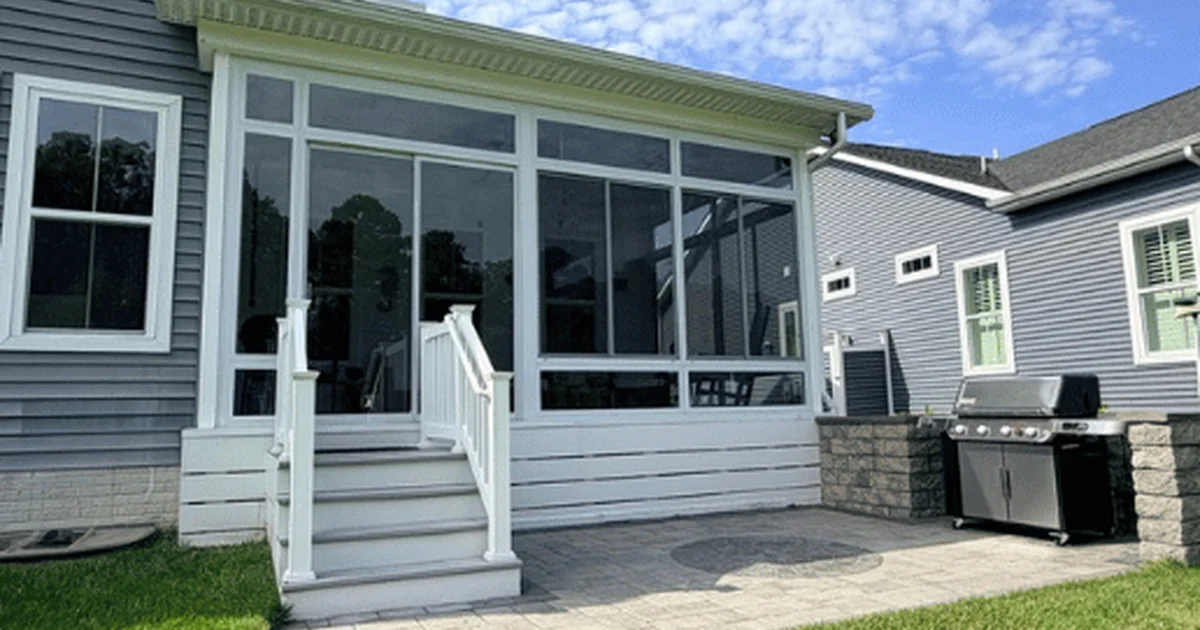
Actual Shore Tint & More installation — Coastal Club · Lewes, DE; 3M Ceramic 45 · sunroom.
View source case study ↗ — Coastal Club · Lewes, DERank your goals
The matrix compares goals, not products. Product performance belongs in the current manufacturer data sheet for the exact film and a matching reference glass.
| If your top goal is… | You'll usually look at | What you give up | Check on your samples |
|---|---|---|---|
| Keeping the room bright | Light, low-reflective solar films | Less glare reduction than a darker film; little added privacy | Does the room still feel bright on a cloudy afternoon? |
| Cutting glare on a TV, screen or water view | A somewhat darker shade on the problem panes | Some daylight, especially on overcast days | Is glare manageable at the worst hour? |
| Daytime privacy from a road or neighbors | Darker or more reflective shades, or frost on selected panes | Daylight and the clear view; reflective films can look mirrored outside | What can you see from outside, by day and after dark? |
| A natural look from outside | Low-reflective light films | Less glare and privacy control | How does the glass look from the yard and street? |
| One room, mixed needs | Different films on different groups of panes | A more complex quote and a less uniform look | Do the films look right next to each other? |
Compare samples side by side
- Ask for two or three candidate samples, including the lightest one that could meet your goal.
- Place them next to each other on the same pane, so you're comparing films rather than different glass or sun angles.
- View them at the time the room is least comfortable, often mid- to late afternoon on west or south glass.
- Look again in the evening with interior lights on. Some films that read clear at midday look different at night, and daytime privacy usually doesn't carry into the evening.
- Step outside and look back at the glass from the yard or street.
- Take photos of each sample in the same position, so you can compare later without relying on memory.
Honest tradeoffs
- A lighter film keeps the room bright but generally reduces glare and adds privacy less than a darker one.
- Clear-looking doesn't mean unchanged daylight; solar-control film generally changes visible-light transmission somewhat.
- Film does not replace insulation, ventilation or other measures needed to manage a sunroom’s comfort.
- Samples on a single pane can look different from a fully treated room. Expect some difference and view the samples in place.
- Film doesn't fix fogged insulated units or failing seals; those are glass problems.
What to ask the estimator
- Which exact product and shade would you put on each group of panes, and why?
- May I have the current manufacturer data sheet for each film, with figures for a reference glass that matches mine where available?
- Have you checked each film against my glass types, including any insulated, Low-E, tempered or overhead panes?
- What would you do differently if my priority were glare or privacy instead of brightness?
- What does the quote include (pane list, removal of old film, cleanup) and what warranty applies, in writing?
- Which samples can I see side by side on my own glass before I decide?
A Delaware example: Coastal Club, Lewes
In a Schell Brothers home at Coastal Club in Lewes, Shore Tint & More treated approximately 200 square feet of sunroom glass with 3M Ceramic 45. The homeowner preferred a low-reflective film, so the glass would keep a natural look rather than a mirrored one. The photo on this page shows that sunroom.
The published project record doesn't include before-and-after temperature, daylight or energy measurements, so we describe the choice, not a result. It shows the decision this guide is about: brightness and appearance first, with heat control from a film chosen to fit those priorities.
FAQ
Can a sunroom stay bright with heat-control film?
Often, with a light film, but expect some change in daylight and less glare and privacy control than a darker film offers. Check samples on your own glass.
Should every pane get the same film?
Not necessarily. Side glass, transoms, doors and roof glass can need different films or different compatibility checks.
How much cooler will the room be?
We can't give a number. It depends on your glass, orientation, shading and ventilation. Ask for the data sheet and be wary of anyone promising a fixed temperature drop.
Does daytime privacy last into the evening?
Usually not. With lights on inside, most solar films show the room at night. Check samples in the evening.
Sources & further reading
- 3M Prestige Series window film — official product page ↗
- 3M building window films — product catalog ↗
- Delaware Window Film — Coastal Club, Lewes sunroom with 3M Ceramic 45 ↗
Product descriptions are summarized from manufacturer materials. We don't reproduce performance figures; request the current data sheet for any product you're quoted.